
Sonoma County Previous Residents Sources
A backward address trail needs a source for each era. The table separates online discovery from counter, library, and archive work. Coverage is not the same as completeness. A source may show a title party, occupant, project, or household without proving every person who used the property.
| Source | Years It Covers | Where Held | What It Shows |
|---|---|---|---|
| Online Recorder index | 1964-present | Sonoma Recorder electronic search | Grantor, grantee, date, instrument type, and reference |
| Earlier deed books and indexes | Before the electronic workflow; 1830-1963 import ongoing | Recorder counter, bound or microfilmed indexes | Earlier title chain and book or page trail |
| Assessor roll and parcel GIS | Current, published monthly | CRA property channel and County Property Hub | APN, situs, parcel geometry, characteristics, and lawful roll fields |
| Permit Sonoma | Current system; default last three years | County Citizen Access; city systems for incorporated parcels | Projects, dates, descriptions, applicants, and parcel or address links |
| Open planning-permit data | Past 48 months | Sonoma County Open Data | Recent record number, status, address, parcel, and description |
| Federal census | Public through 1950 as of 2026 | National Archives, library databases, and genealogy channels | Enumerated household and location clues by schedule and district |
| Directories and reverse sections | 1870s to early 1950s overall, plus named local runs | Sonoma Library, Petaluma rooms, and digital collections | Occupant, head of household, route, locality, and sometimes spouse |
| Sanborn maps | Exact local years must be checked | Library and Library of Congress collections | Building footprint, use, street number, and physical change |
| Probate and obituaries | Case or publication dependent | Sonoma Superior Court and library newspaper resources | Death, heirs, personal representative, and a trail endpoint |
For a recent transfer, start with the parcel and Recorder. For an older household, add the directory and census layers early. For a structure that burned, was rebuilt, or changed numbers, bring in permits and maps before trusting an address string.
Sonoma County Deed Chain Backward
Begin with the current situs and APN. Use the assessor or parcel map to identify the land, then carry the current document number into the Recorder index. The acquisition deed names a grantee, the person or entity receiving the interest, and a grantor, the person or entity conveying it. Search the grantor earlier as a grantee. Repeat the chain, checking the APN and legal description at every turn.
- Normalize the current situs, note the APN, and save the legal description or subdivision reference.
- Find the current acquisition instrument by document number, party name, date, or type.
- Read the seller or conveying party as the next earlier link, then search that party as grantee.
- Separate deeds from deeds of trust, reconveyances, liens, and quitclaims before calling an instrument a transfer.
- At the 1964 online boundary, move to Recorder counter indexes, bound books, microfilm, or book and page references.
- Grantor and grantee
- The grantor conveys an interest; the grantee receives it in the recorded instrument.
- Chain of title
- The linked sequence of recorded interests that connects one title holder to an earlier one.
- Legal description
- The deed's land identity, such as lot and block, subdivision map, or metes and bounds.
A street line is a helpful search clue, but legal description and APN are the continuity spine. The Recorder warns that its index is a catalog rather than the underlying document. Staff can explain copy procedures, yet they do not conduct title research or choose a document for the requester.
Sonoma County Recorder Cutoff
The online Recorder workflow reaches 1964 for the modern electronic name search. The FY 2025-26 county budget says 1830-1963 documents are still being imported. That combination means an early result can be incomplete online while the county still has a counter, book, or index route. Search spelling variants and historical abbreviations, especially for pre-2010 entries. After January 1, 2010, the exact person or company name is the better first try.
Use a current document number when one is available, but do not assume that a blank name search ends the prior-resident question. The earlier channel may require the party role, a date range, book and page, legal description, or help locating the right bound index. A focused copy request should identify the document number and type. It should not ask staff to create a complete title history.
This is a useful Sonoma insider point: the import project and the older counter indexes are part of one trail. “Not on the web” and “does not exist” are different statements.
Sonoma County House History Guide
The local house-history method joins deeds, assessor records, historical maps and atlases, aerial photos, directories, permits, tax assessments, newspapers, cemetery and vital indexes, probate, and archives. A fire can leave the APN and deed chain in place while changing the structure, occupant sequence, street appearance, and permit trail. For that reason, the previous residents of a parcel should be separated from the history of one particular building on it.
The Sonoma historic-property research guide lays out that local source path, including maps, directories, permits, tax material, newspapers, and archive work.
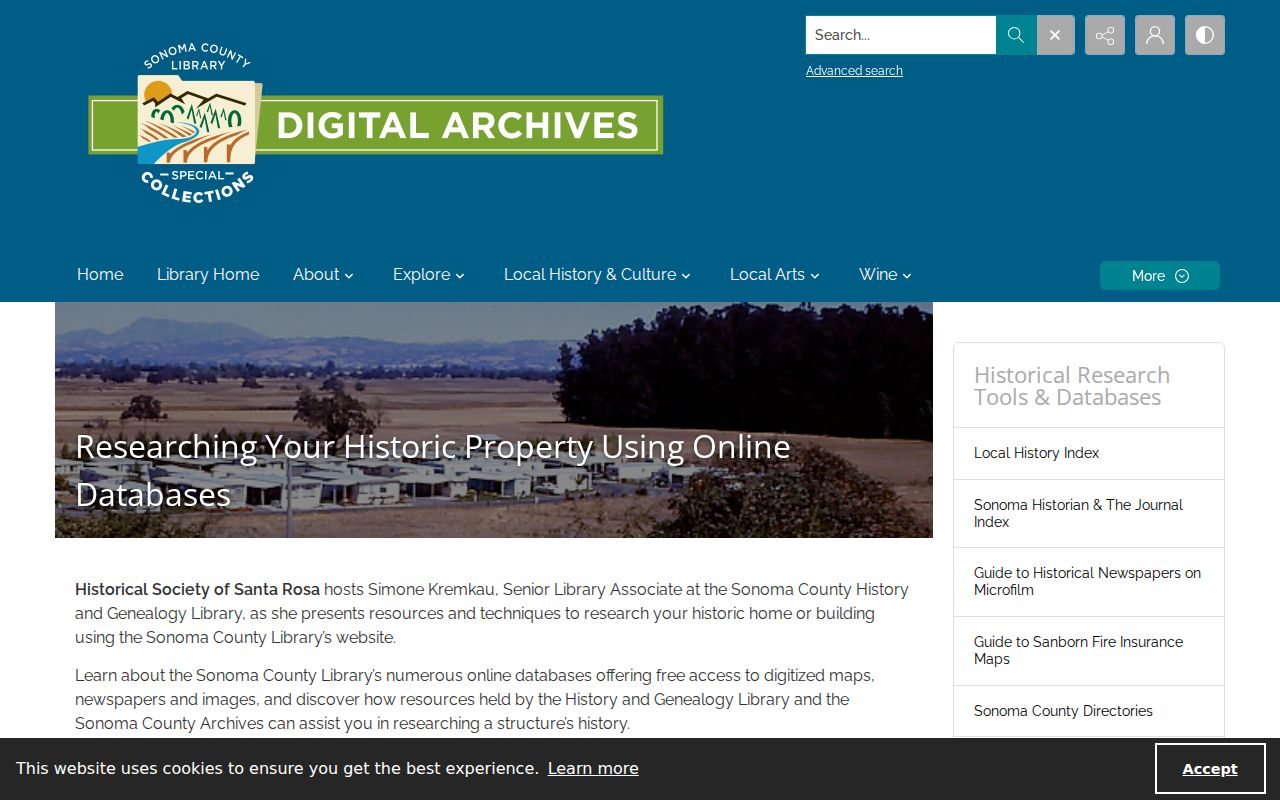
The guide helps place a directory or permit line in the physical history of the parcel without making the building and land sound like the same record.
Santa Rosa's older core, Petaluma and Sonoma's nineteenth-century areas, postwar subdivisions, and rural Russian River communities can call for different maps and directory runs. Exact Sanborn town and year holdings must be checked rather than inferred from a countywide list.
Sonoma County Previous Households
Title records identify interests in land. Directories and census schedules are the better sources for earlier household clues. Sonoma County directories span the 1870s into the early 1950s overall, with named 1922-23 and 1954-55 volumes that have different scope. The latest public federal census is 1950 as of 2026. A directory may show an occupant or head of household while the census shows the people enumerated there; neither should be treated as a complete live roster.
- Transcribe the address, route, locality, name, page, and publication year from the directory.
- Browse the preceding and following available edition, including any reverse or criss-cross section.
- Pair the year with the nearest released census and its enumeration district or street clue.
- Search newspapers and obituaries for death, marriage, move, business, or family context.
- Use probate, cemetery, and recorded succession documents to close or test the household trail.
A first or last appearance narrows a period but does not prove arrival or departure. Rural routes, missed canvasses, seasonal use, and publication gaps can all create a false edge. The Sonoma County city directory collections hold the detailed volume and abbreviation guidance; this backward trail uses them to answer one address question.
Sonoma County Maps And Permits
Permit Sonoma defaults to the last three years on several modules, but a blank Start Date broadens the loaded search. The open planning-permit dataset supplies the past 48 months as a second recent channel. Use the parcel number and address together, then check the city permit custodian when the property is incorporated. A permit can reveal an addition, demolition, rebuild, well, septic project, or code record without identifying every person who used the structure.
Maps add the physical check. Sanborn pages can show a footprint, use, street number, and building change for an exact local year, but the complete Sonoma year list was not verified. Historical atlases, aerials, parcel geometry, and legal descriptions can bridge a road alias or subdivision change. If a road text search fails, the APN and land description should lead.
The Online Archive of California source shows how a house-history image can sit within the map and permit trail.
Finding aids can point to maps and records that are not digitized, so an archive reference is a next step rather than a finished household claim.
Sonoma County Archives And Routes
Sonoma County Library became the official county archives in 1965, and the California Room opened in 1967. Current archive holdings exceed 5,000 cubic feet, most material is not digitized, and Offsite catalog items need an advance request. That local history explains why a previous-resident search may move from an online directory to a catalog, then to staff retrieval or a microfilm reader.
The California State Archives and the Online Archive of California offer broader finding-aid routes for state and regional material. Use a named series, place, family, organization, or date. Do not treat a catalog hit as proof that a scan is available or that the collection contains every resident.
The California State Archives source gives a broader archival context for a Sonoma County previous-residents search.
Archive catalogs are most useful when the parcel, locality, or person's name has already been narrowed to a record series.
Rural roads create a special local quirk. Older directories may use route, post office, resort, or locality language instead of today's number. The Russian River communities, remote coast, and farm areas can also appear under an older community name. Compare a directory heading, historical map, and current parcel before treating two address strings as one place.
Sonoma County Human History Trail
Probate and obituary evidence can turn a past resident's name into a relationship trail. The Historical Records Commission publishes a Recorder Inventory 1834-1986, wills index 1850-1900, guardianship bonds 1851-1907, official bonds and oaths 1854-1954, and census publications for 1850, 1852, and 1860. A will abstract can name heirs, while a probate file can identify a personal representative and an order affecting property. Those records should be tied back to the parcel and date.
The Commission's publication order page documents those local indexes and prices. A publication is an index or finding aid, not a replacement for the underlying court or county record. The prior-resident claim should say whether the source shows an owner, heir, occupant, or event.
Yearbooks and local school archives can help with a former classmate or community history question. Santa Rosa Junior College library and archive information is a collection-level lead, not an exhaustive public alumni directory.
The Historical Records Commission publications make a dispersed local record trail easier to search while preserving the need for source and date checks.
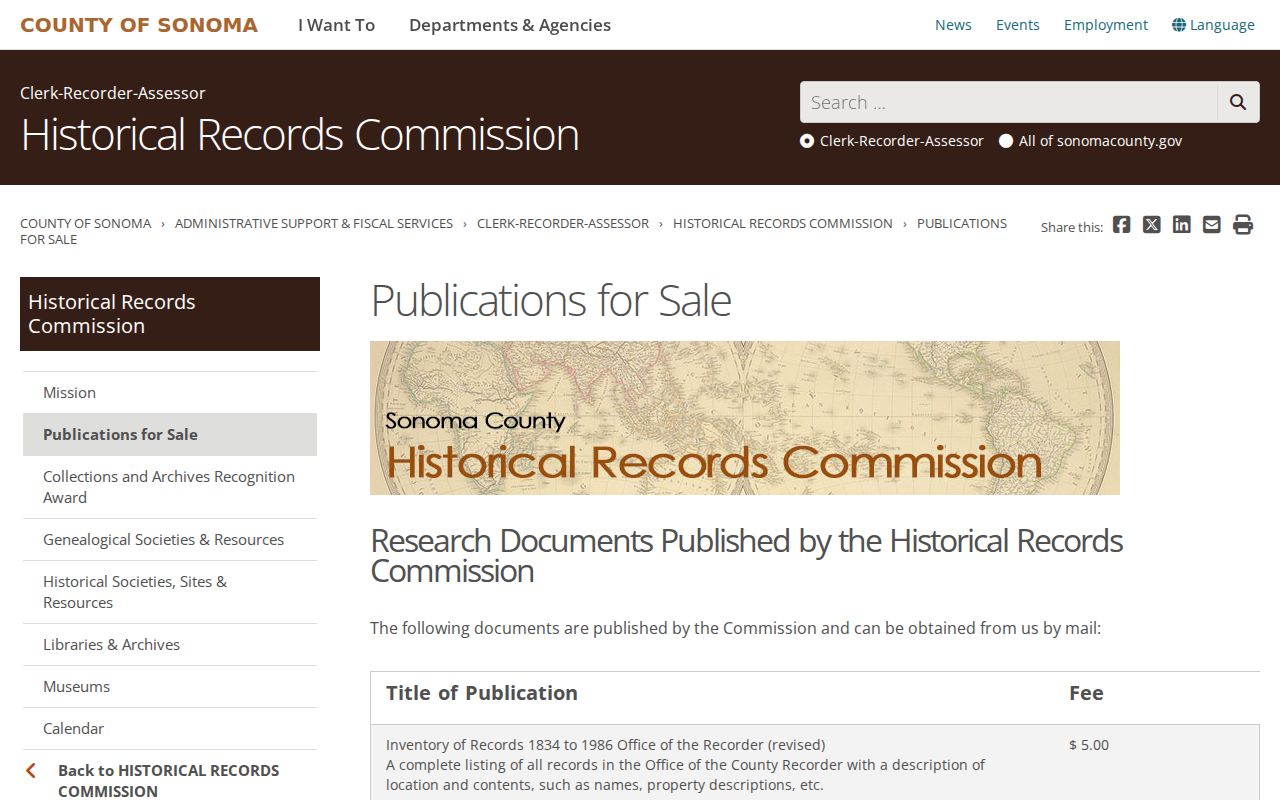
The Commission's indexes make a dispersed local record trail easier to search while preserving the need for source and date checks.
The Santa Rosa Junior College libraries can be a useful route for yearbooks and collection-level school history when the question is a former classmate rather than a title owner.
School or yearbook evidence can corroborate a name and year, but it should not be expanded into a current address or complete alumni list.
Sonoma County Previous Residents Limits
Ownership is not occupancy. A title holder may have lived elsewhere, and a directory occupant may not have owned the parcel. A fire can reset the building story while the land chain continues. A rural-route change, annexation, alias, or number change can make a text address disappear. The strongest evidence timeline labels each claim as title, likely occupant, household, building, or public event.
Lawful house history. Research into Sonoma County previous residents is appropriate for personal house history, genealogy, estate work, and civic records review. California Penal Code sections 646.9, 422, and 653m and Code of Civil Procedure section 527.6 limit stalking, threats, repeated unwanted contact, and harassment. Do not use an address history to stalk, track, intimidate, or harm any living person.
A careful stopping point is part of the method. If the chain reaches an archive, a protected record, or an unresolved same-name collision, preserve the last supported fact and identify the custodian that may hold the next record. The previous residents of a Sonoma County address become a defensible history only when the source, date, land key, and human role stay visible.